What Is RCS Business Messaging? The 2026 Guide
SendSeven Team, Editorial Team
RCS is the successor to SMS and a real alternative to WhatsApp: a branded sender, images and buttons right inside the phone's default messaging app, with no app for the customer to install. This guide explains what RCS Business Messaging can do, how it differs from SMS and WhatsApp, and how widely available it already is.
TL;DR
RCS Business Messaging (RBM) is the business branch of Rich Communication Services, the GSMA's successor to SMS. Instead of 160 plain characters, a business sends a branded sender with logo and checkmark, plus images, buttons and short videos, right inside the phone's preinstalled messaging app. That makes RCS a real alternative to WhatsApp: branded and interactive, but with no app to install and no dependence on Meta. In the United States and the UK, RCS runs on most Android phones through Google Messages, and since iOS 18 many iPhones can receive it too, depending on the carrier. At SendSeven, RCS is available for accounts with a German billing address. You request it in the app, and the prices are fixed per agent type. Recipients without RCS you reach over SMS, bundled with every other channel in one central inbox.
What is RCS Business Messaging?
RCS Business Messaging is the branded messaging channel businesses use to reach customers right inside the phone's default messaging app, with a logo, images, buttons and read receipts instead of plain SMS text. RCS stands for Rich Communication Services, a standard from the GSMA, the worldwide industry body of mobile network operators. It is the official successor to SMS and is already built into modern smartphones.
The distinction between two terms matters here. RCS is the general standard, which also covers private chats between two people. RCS Business Messaging, or RBM for short, is the application-to-person branch for businesses, the way a brand communicates with its customers, whether automated or in customer service. Whenever this guide refers to RCS in a business context, we mean RBM.
The appeal for a business is obvious. Everyone knows SMS, SMS works on every device, but SMS looks like 1995: gray text, no images, no clickable button, no recognizable sender. RCS removes exactly those limits, without the customer having to install an extra app. The message lands in the same app that already receives the SMS.
One point to place the channels cleanly: RCS belongs to the world of Google, the GSMA and the mobile carriers. Google's platform for RBM is called Jibe, and the underlying standard is the GSMA Universal Profile. That is explicitly not the same ecosystem as WhatsApp, which belongs to Meta. So anyone comparing RCS and WhatsApp is comparing two different worlds with different logic.
RCS, SMS and WhatsApp compared
Three mobile channels, three different strengths. A business deciding where to send which message should understand the differences, rather than writing off RCS as either a silver bullet or pointless.
SMS is the universal delivery channel: it reaches practically every mobile phone, needs no app and no internet connection, but it is functionally poor. WhatsApp is a high-reach messenger and offers rich media plus end-to-end encryption, but it requires the customer to have the app installed. RCS sits in between: rich in features like WhatsApp, delivered through the preinstalled messaging app like SMS, with a branded sender as a trust anchor. You need an opt-in on all three channels, and RCS requires it just as strictly as WhatsApp does.
| Attribute | RCS (RBM) | SMS | |
|---|---|---|---|
| Reach | Most Android phones; growing on iPhone | Nearly every mobile phone | Very high, especially outside North America |
| Rich media (image, video, buttons) | Yes | No, text only | Yes |
| Extra app needed? | No, runs in the default messaging app | No | Yes, app installation required |
| Opt-in needed? | Yes, strictly required | Yes, required for marketing | Yes, strictly required |
| Encryption in business use | Transit-encrypted (TLS 1.3), not end-to-end | No end-to-end encryption | End-to-end encrypted |
| Sender presentation | Verified sender with name, logo, checkmark | Number or alphanumeric, easily spoofed | Verified business profile |
| Typical use | Branded notifications, service, commerce | OTP, critical alerts, universal delivery | Dialogue, campaigns, conversational commerce |
One clarification that often gets lost in marketing copy: RCS has not overtaken WhatsApp. The two channels coexist. But RCS is a genuine, standalone alternative to WhatsApp: a different ecosystem (Google, GSMA and mobile carriers instead of Meta), with no app installation, and a branded sender right inside the default app. For many businesses, that is exactly the reason to fold RCS into a well-considered multichannel strategy.
How RBM works
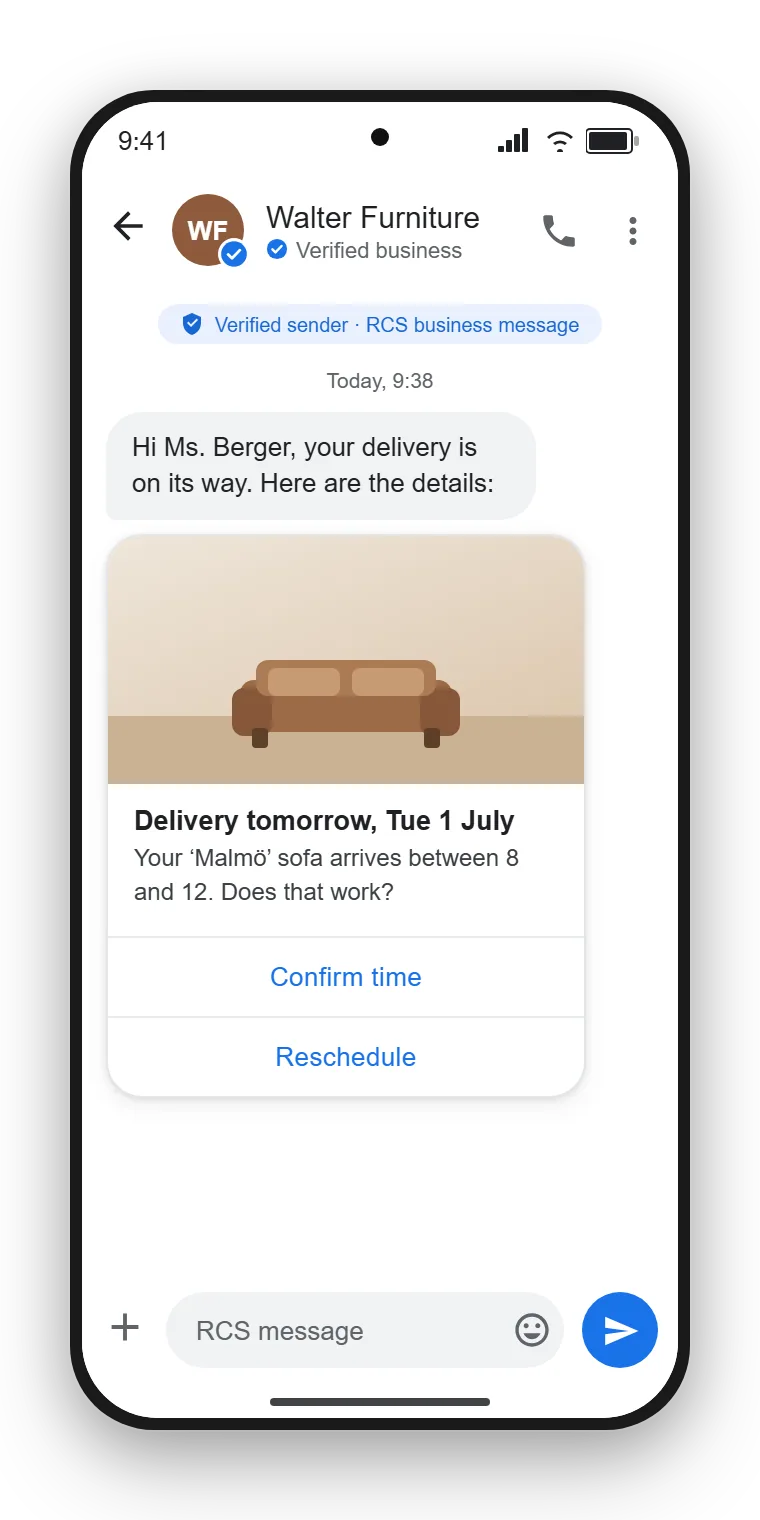
The biggest visible difference from SMS is the verified sender, often called a brand agent. Instead of an anonymous number, the recipient sees the brand name, the logo and a verification checkmark. That builds trust and makes it harder for fraudsters to impersonate your business. To switch on this branded sender, the brand goes through agent registration and brand verification, usually handled via an aggregator.
On the content side, RBM brings building blocks that SMS simply does not have:
- Rich Cards and carousels. A card with an image, headline, description and action buttons, for a single product or offer. Several Rich Cards side by side form a carousel for swiping, ideal for a small product selection.
- Suggested replies. Ready-made tap replies the customer responds with in a single tap, rather than typing freely.
- Suggested actions. Buttons that trigger an action: open a link, call a number, show a location on the map or add an appointment to the calendar.
- Read receipts and typing indicator. The business sees whether a message was delivered and read, and the customer sees that someone is typing, just like in a messenger.
- Rich media. An image, short video or file can be sent directly in the chat.
Technically, this runs behind the scenes over the mobile world's RBM platform, described in the standard as MaaP, or Messaging as a Platform. None of this is visible to the business; only the result in the chat window counts.
A practical comparison makes the leap from SMS to RBM tangible.
| Feature | RCS (RBM) | SMS |
|---|---|---|
| Sender | Verified brand name with logo and checkmark | Number or alphanumeric |
| Content | Text, image, video, file, Rich Cards | Text only |
| Interaction | Suggested replies and actions via button | Reply as free text only |
| Delivery status | Delivered and read both visible | Usually delivered only |
| Character limit | No practically noticeable limit | 160 characters per segment |
Reach and iPhone support
Reach is the question that decides whether RCS is relevant for a business. The honest answer: relevant yes, ubiquitous not yet.
On Android, RCS has been the standard through Google Messages for years and is usually active out of the box. As a market example: in Germany, RCS reaches about 70 million people, according to the four German carriers. That figure is not a fixed constant; it depends on the device mix of the audience and on the mobile network. The picture is similar across other developed markets where carriers have rolled out the Universal Profile.
The long-standing sore point was the iPhone. That has changed: since iOS 18, which shipped in September 2024, the iPhone can receive RCS, in selected markets and with mobile carriers that support the standard. One detail worth knowing: a conversation between an iPhone and an Android device still shows as a green bubble on the iPhone, not the blue iMessage bubble. So RCS improves the features across platform lines without removing the visual divide.
| Device / situation | RCS available? | Note |
|---|---|---|
| Android with Google Messages | Yes, usually active out of the box | The established RCS standard |
| iPhone on iOS 18 and later | Yes, in supported markets and networks | Depends on the carrier supporting it |
| iPhone and Android in one chat | Yes, with RCS features | Stays a green bubble on the iPhone |
| Older device or no RCS network | No | SMS fallback, if the sending platform provides it |
This very SMS fallback keeps RCS predictable: where RCS is not available on the recipient's device, the same information can be delivered as an SMS. It does not happen by itself, the fallback is triggered by the sending platform. At SendSeven, SMS is a separate channel in the same platform today, and an automatic fallback straight out of an RCS send is in preparation and not yet available.
Security and GDPR: a brief note
One point should be stated fairly, without dramatizing it: RBM messages are transit-encrypted to industry standard (TLS 1.3) between the device, Google's RBM platform and the connected partner, but not end-to-end encrypted, because the platform has to be able to check messages for spam and abuse. Private consumer RCS chats did gain end-to-end encryption, in beta, in May 2026, but business RBM is not covered by that.
The decisive protection in business messaging is a different one anyway: the verified sender. If a sender cannot be spoofed, no one can impersonate your business, and that addresses the most common real threat, phishing. For GDPR, the rule is: RBM can be run through a partner with EU-compliant processing, but highly sensitive content does not belong in a messaging channel unchecked. Anyone who takes GDPR-compliant messaging seriously pays attention to the processing location, data processing agreements and a clean opt-in.
Use cases by occasion
RCS plays to its strengths wherever a message needs to do more than plain text, but the customer is not reachable over a messenger. Here are the typical occasions and the channel fit that makes sense for each.
Marketing. An offer with a product image, carousel and action button can show the customer much more on RCS than a plain-text SMS. For pure reach across all devices, SMS remains the safe foundation.
Service. Order confirmation, shipping status with a map and tracking button, status changes: RCS turns a bare status alert into a useful, interactive message.
OTP and security. One-time codes above all need reliability and universal delivery. Here SMS is still the standard; RCS can complement it where the branded sender raises fraud protection.
Appointments. Appointment reminders with a confirm button or a suggested action that drops the appointment straight into the calendar let customers confirm or reschedule in a single tap.
Commerce. Product carousel, in-chat advice, payment link: RCS is well suited to lightweight conversational commerce, without the customer having to open an app.
Reactivation. When you want to win back inactive customers, a branded message with an image and a clear button stands out more than an anonymous text SMS.
| Occasion | Recommended fit | Why |
|---|---|---|
| Marketing offer | RCS, SMS as fallback | Image and button say more than text |
| Shipping and service status | RCS | Map and tracking button in the chat |
| One-time code (OTP) | SMS | Maximum delivery reliability |
| Appointment reminder | RCS, SMS as fallback | Confirm and calendar button |
| Advice and sales | RCS or messenger | Dialogue with rich media, mind the opt-in |
| Reactivation | RCS, SMS as fallback | Branded sender stands out from anonymous SMS |
Set up RCS for your brand
RCS is available at SendSeven for accounts with a German billing address. You request it in the app under Settings → Connected Channels, SendSeven sets up and manages your agent, and Google and the carriers check it. SMS, WhatsApp, email and live chat run in the same inbox.
Questions? Email [email protected]What does RCS Business Messaging cost?
RBM prices depend heavily on the market, the mobile carrier and the aggregator. So first the model behind them, so you know what to look out for, and then SendSeven's concrete prices.
Depending on the market and provider, RBM is usually billed either per message or per conversation. With per-conversation billing, a window of bundled messages is counted as one unit, similar to the logic many will recognize from the WhatsApp world. On top of that, depending on the region, come one-time or recurring costs for registering and verifying the branded sender, typically through the aggregator.
The distinction from SMS matters. The SMS price is not the RCS price. Anyone building an RCS calculation should look at RCS and the SMS fallback separately, because a message delivered as an SMS follows the SMS logic. At SendSeven, fixed list prices apply per agent type, net of VAT:
| Agent type | List price (net) | Billed per |
|---|---|---|
| One-way (no replies), rich message | EUR 0.079 | Message |
| One-way (no replies), plain text up to 160 characters | EUR 0.065 | Message |
| Conversational | EUR 0.11 | Session |
For One-way and Conversational, the SendSeven message fee of your plan comes on top. The messages included in your plan cover that fee until they are used up. A session starts when the recipient replies, lasts 24 hours and covers up to 999 messages. The Newsletter is an agent type of its own, priced per recipient per month; its conditions are on the German RCS page.
RCS is paid from a prepaid balance, and the carrier part is charged only on confirmed delivery. Before you submit, you top up at least EUR 100. The amount is credited to your balance, it is not a fee, and it is refunded if you cancel before launch. The prices for the other channels are laid out transparently on the pricing page.
RCS and SendSeven
At SendSeven, RCS is available for accounts with a German billing address. You request it in the app under Settings → Connected Channels and choose the agent type: Newsletter, One-way (no replies) or Conversational. SendSeven sets up and manages your agent, while Google and the mobile carriers check it. Sending starts once all of them have approved it. If you have questions before you request, write to [email protected]. RCS follows the same logic as the other channels: one central inbox where all conversations come together, instead of scattered tools.
Alongside it, the direct mobile channel SMS stays important. It reaches practically every mobile phone and covers exactly those recipients whose device or network does not support RCS. Both channels sit in the same platform, so you decide per occasion which one fits.
Beyond the individual channels, the central inbox is the bracket that holds it together: WhatsApp, SMS, email, Instagram, Messenger and live chat come together in one interface, so your team does not jump between apps. SendSeven is a company from Germany, SendSeven GmbH, based in Augsburg, which hosts the platform in the EU and works in a GDPR-compliant way. The principle behind it stays the same across every channel: automated where it helps, personal where it counts.
Frequently asked questions
What is RCS Business Messaging?
RCS Business Messaging, RBM for short, is the business branch of Rich Communication Services, the GSMA's successor to SMS. Businesses use it to reach customers right inside the phone's default messaging app, but with a branded sender, images, buttons and read receipts instead of plain SMS text.
What is the difference between RCS and RBM?
RCS is the general standard, which also covers private chats between two people. RBM, or RCS Business Messaging, is the application-to-person branch specifically for communication between businesses and customers.
How does RCS differ from WhatsApp?
RCS belongs to the world of Google, the GSMA and the mobile carriers and runs in the preinstalled messaging app with no extra installation. WhatsApp belongs to Meta, requires an installed app, and is end-to-end encrypted. RCS requires an opt-in just as strictly as WhatsApp does. RCS has not overtaken WhatsApp; the two serve different strengths.
How large is the reach of RCS?
RCS reaches most Android phones, where it is the standard through Google Messages, and is growing on iPhone since iOS 18. As a market example, in Germany RCS reaches about 70 million people, according to the four German carriers. Actual reach depends on the device mix of the audience and on the mobile network.
Does RCS work on the iPhone?
Yes. Since iOS 18, which shipped in September 2024, the iPhone can receive RCS, in selected markets and with mobile carriers that support the standard. A conversation between iPhone and Android does, however, stay a green bubble on the iPhone.
Is RCS Business Messaging end-to-end encrypted?
No. Business RBM is transit-encrypted to industry standard with TLS 1.3, but not end-to-end encrypted, because the platform has to check messages for spam and harmful content. Private consumer RCS chats between two people gained end-to-end encryption, in beta, in May 2026, but business RBM is not covered by that.
Can RCS be used in a GDPR-compliant way?
RBM is transit-encrypted and can be run through a partner with EU-compliant processing. Businesses should know and document that the messages are not end-to-end encrypted, pay attention to the processing location and obtain a clean opt-in. Highly sensitive content does not belong in an RBM channel unchecked.
What happens if the recipient does not have RCS?
Then you reach them by SMS. Such a fallback is triggered by the sending platform, it does not happen by itself. At SendSeven, SMS is a separate channel in the same platform and the same inbox, and an automatic fallback straight out of an RCS send is in preparation and not yet available.
What does RCS Business Messaging cost?
Depending on the market, mobile carrier and aggregator, RBM is usually billed per message or per conversation, on top of which come costs for registering and verifying the sender. There is no single market price, and the SMS price is not the RCS price. At SendSeven, One-way costs EUR 0.079 per rich message (EUR 0.065 for plain text up to 160 characters) and Conversational EUR 0.11 per session, each net of VAT and plus the SendSeven message fee of your plan. The Newsletter agent type has its own conditions, which are on the German RCS page.
Can I already use RCS with SendSeven?
Yes, if your account has a German billing address. You request RCS in the SendSeven app under Settings → Connected Channels. SendSeven sets up and manages your agent, Google and the mobile carriers check it, and you can send once all of them have approved it. Questions before you request: [email protected]. Recipients without RCS you reach by SMS, bundled with WhatsApp, email, Instagram, Messenger and live chat in one central inbox.
Conclusion and next steps
RCS Business Messaging is the logical evolution of SMS: a branded sender, images, buttons and read receipts, delivered through the app that is already on most smartphones. RCS reaches most Android phones, and with iOS 18 the iPhone gap is narrowing, depending on the carrier. Where RCS does not arrive, SMS takes over delivery, as a separate channel in the same platform.
For all the enthusiasm, an honest look is worth it: business RBM is transit-encrypted, not end-to-end. The protection against fraud comes from the verified sender, not from content encryption. Knowing that, you can deploy RCS deliberately and with GDPR in mind, rather than blindly following a marketing promise.
Next steps:
- RCS explained for small businesses, a plain-language walkthrough of what RCS looks like, who can receive it, and what it costs
- Questions before you request RCS, answered by email; the request itself is made in the app, for accounts with a German billing address
- Explore the SMS channel, the direct mobile route for recipients without RCS
- Central inbox, where all channels come together
- View SendSeven plans, transparent from EUR 49/month on the Basic plan
Want to dig deeper into individual terms? In the glossary we explain RCS, RCS Carousel and Universal Profile concisely and clearly. And if you want to set up the direct mobile channel the right way today, the piece on SMS marketing covers the basics, with everything held together in a single unified inbox.